
R.S. Hughes is a California-based industrial distributor with 550 employees and $515M in annual revenue, serving 60,000 customers out of a catalog of more than 900,000 SKUs.
At a glance

- Industry
- Industrial
- Employees
- 550
- Revenue
- $515M
- Website
- rshughes.com
- Proton products
- eCommerce AI
In 2020, the company set out to do one specific thing: improve how its ecommerce site recommended products to buyers. Nobody expected that project to end up rebuilding the sales strategy around it. That is what happened.
The challenge: a catalog too wide for click-based guesses
The goal was simple to state. “We needed relevant recommendations,” said Mike Page, R.S. Hughes' Chief Marketing Officer and Chief Technology Officer. “As we learn about you and your behavior on the website as a regular customer, we now understand your order pattern and your reorder behavior.”
Getting there was the hard part. Traditional recommendation engines watch what a shopper clicks — and across 60,000 customers and more than 900,000 SKUs, browsing behavior alone wasn't cutting it. The team quickly realized those engines couldn't deliver the depth of insight B2B distribution needs.
Why Proton: an engine that reads more than clicks
Page was eventually introduced to Proton, an AI-powered sales platform built specifically for distributors. Where other ecommerce recommendation tools relied on web browsing behavior, Proton's model started from somewhere else entirely.

“The Proton.ai solution uses AI to digest a massive amount of data and make sense of it. The products are just one component. The data also looks at the type of customer, the location of the customer, what we know about similar customers. It considers many different data points that would be difficult to analyze without machine learning.”
 Mike Page · CMO & CTO, R.S. Hughes
The pilot: ten years of history, 90 days to prove it
Page agreed to feed data from R.S. Hughes' Infor SX.e ERP into Proton for a 90-day pilot. A dozen business development reps were asked to work the system's recommendations into their daily customer calls.
Proton had one request before any of it started: as much data as possible. “So we gave them millions and millions of lines of transactional data, customer data,” Page said. “I think we might have plugged in 10 years of history, including customers who buy from us and those who have stopped buying. It's a very powerful system.”
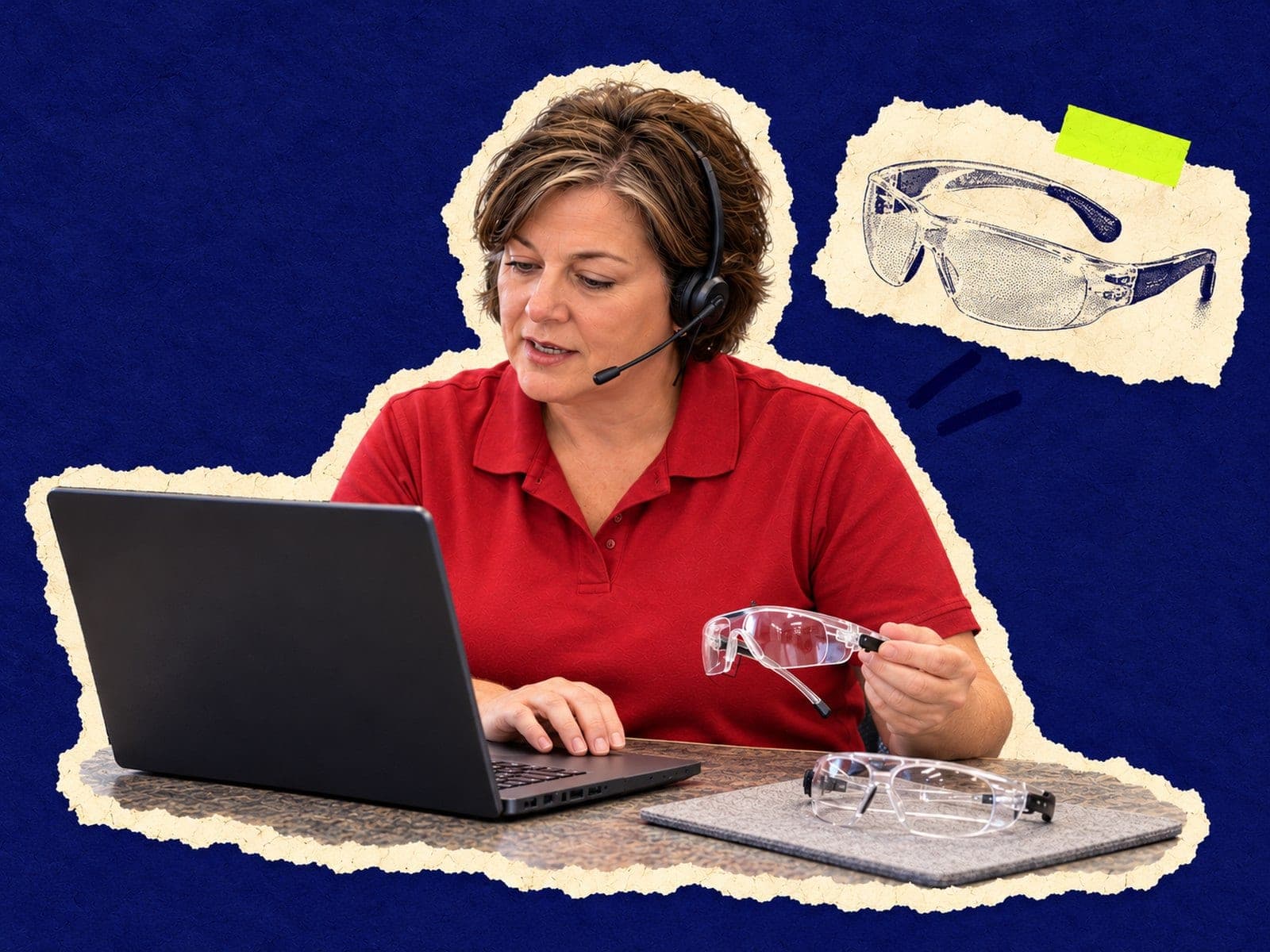
That history is what makes a recommendation specific rather than generic. If a customer buys safety glasses on a regular cadence and hasn't placed an order in a while, the system tells a rep to ask about a reorder today.
“Additionally, because we've learned about that particular customer, we can learn about the purchasing history of similar customers and the engine will provide some relevant guidance,” Page explained.
The AI now powers sales activity across R.S. Hughes' 175 inside sales reps, who collectively serve around 10,000 customers. It prioritizes their outreach and tailors each conversation to that customer's purchase history and behavior.
Before
With Proton
Call plans
BeforeReps built their own plans out of the company database and decided what to prioritize.
With ProtonA personalized daily game plan: who to call today, and what to talk to them about.
Recommendations
BeforeSuggestions drawn from web browsing behavior alone, across 900,000+ SKUs.
With ProtonOrder patterns, customer type, location, and the behavior of similar customers, weighed together.
Sales history
BeforeTen years of transactional data sitting inside Infor SX.e.
With ProtonMillions of lines of it feeding the engine — including the customers who stopped buying.
The results: faster ramp-up, sharper conversations, immediate ROI
The pilot came back stronger than expected — and the biggest wins landed in places the project was never scoped to touch.
New salespeople up to speed much faster
“We got so much more out of it than we expected, because it helped the new salespeople get up to speed much faster,” Page said. Veterans benefited too, moving faster and making better decisions based on live data.
A daily game plan instead of a research project
Before Proton, much of a rep's time went into building call plans and working out what to prioritize. Now the system cuts straight to the next best action.
“The data tells you, here's who you need to talk to today. Here's the content you need to talk to them about,” Page said. “It's the stuff we historically built from our own database, but now we're moving right into relevant action steps and doing so much quicker.”
Well over seven figures in attributed revenue
“The ROI on the e-commerce piece alone was immediate,” Page said. “We've seen well over seven figures in attributed revenue and hundreds of thousands of clicks for attribution to engage on those recommendations.”
Ecommerce grown into a quarter of the business
Since launching its website in 2014, R.S. Hughes has grown ecommerce to account for about 25% of annual revenue. Proton has played a key role in that acceleration.
Beyond ecommerce: from inside sales to the entire sales team
The early success with inside reps made the next decision easy. R.S. Hughes expanded the rollout across the organization, and outside sales reps will have access from a desktop, tablet, or mobile.
“The relationship with Proton has turned into a significant part of our growth engine in the company, and not just in e-commerce. We've expanded into our inside sales group, and we're just about now ready to turn it all over to our outside sales group.”
Mike Page · CMO & CTO, R.S. HughesIt has also stopped being a product-recommendation tool. “The Proton.ai engine is now going to be the heart and soul of our client engagement on a reactive sense, in a recommendation sense, and affect our customer relationship management behavior,” Page said.
The same engine now shapes promotions, not just individual sales calls. “We're taking many data points about customers and behaviors and product purchasing patterns, and correlating those together with the AI engine to provide the due-to-reorder product recommendations that go together, and then we have an opportunity to add campaign or promotional direction into that too,” Page said.
The bottom line: a project that outgrew its brief
R.S. Hughes went looking for better product recommendations on its website. What it got was a system that tells 175 inside reps who to call and what to say, helped accelerate an ecommerce channel now worth about a quarter of revenue, and is on its way to the outside sales team.
And it compounds. “Over time, the engine continues to digest data and learn and grow, so it keeps getting better all the time,” Page said.
Adapted from an article that originally appeared in the March/April 2022 issue of Industrial Supply magazine.